
Should I Go on a Float or a Hike?
You've read what a VLTAT actually is. (If you haven’t yet, go to this page on our website) You've met The Squad. You know this isn't survival training dressed up as therapy, it's a real trip with real gear support, run by veterans who've been where you are. Now you're staring at an application with two options in front of you, and you don't know which one is actually built for you.
Here's what we can tell you honestly.
What's True on Both
Before you weigh float against hike, understand what doesn't change no matter which one you pick. Every VLTAT runs four days and three nights. Every trip caps at fifteen veterans, with a two to one participant to team leader ratio, and every one of those leaders is Psych Armor certified. Every trip includes cold water immersion, and it's always voluntary, nobody's forcing you into a creek if you don't want to go. Every trip includes morning breath-work and meditation, and structured talks built into the schedule, not bolted on as an afterthought. Every trip is backed by the best medical kit we can put together and trained medic volunteers on the ground. And every trip covers your lodging the night before and after, with a shuttle waiting for you at Great Falls International.
None of that changes based on which trip you choose. The therapeutic core is identical: physical challenge, peer camaraderie, immersion in Montana, and instruction from veterans who've led before. What changes is the terrain you do it on, and what that terrain asks of you.
The Float
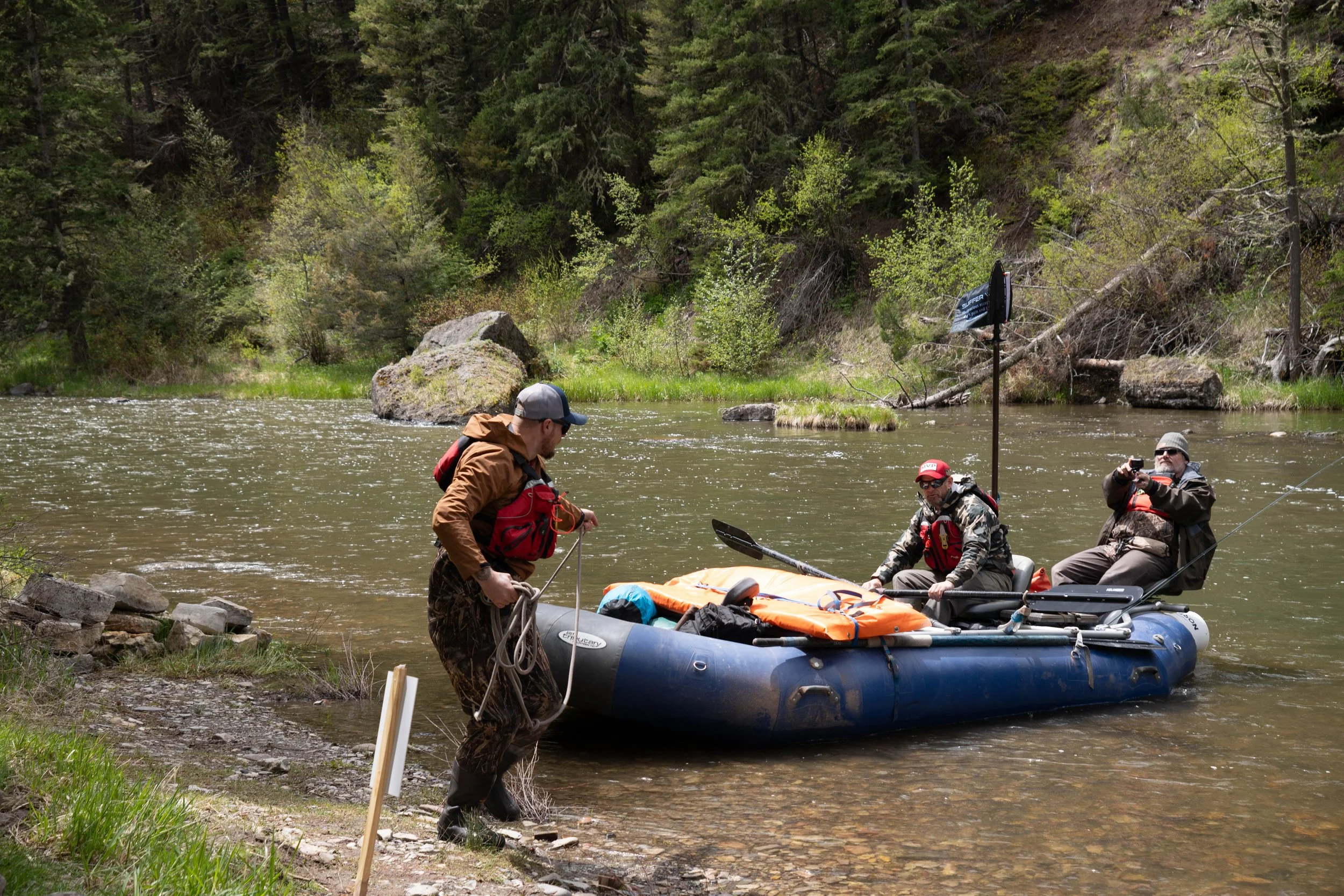
coming to shore for a lunch break
The float happens on the Smith River, and right now, that's the only place we run it. Team leaders are skilled rowers, and they're ready to put in all fifty nine miles themselves if that's what a veteran needs. If you want to learn to row, they'll teach you. If you'd rather sit back and take it in, that's fine too.
A day on the water covers somewhere between twelve and sixteen miles. There's no hard wake up time, but there's coffee waiting before the morning routine kicks off. You break camp, load the boats, and get moving. Some mornings there's work waiting at the camp itself, so that gets done before takedown. Other days you'll float until there's work to do downriver, or stop where the river gives you a reason to, handprints on a cliff wall, a good fishing hole, whatever the Smith puts in front of you that day. You work a few camps along the way, and the goal every evening is making it to that night's camp before the sun goes down, so there's time to cook.
Food on the river is fresh, cooked that night, nothing freeze dried. Lunch is sandwiches or wraps put together on the shore. Around supper, or sometimes at the fire in the morning, you'll run two to three classes a day.
The real challenge on a float isn't the mileage. It's Montana. Weather is the biggest variable, snow in July, hail with no warning, conditions that test you no matter how in shape you are. That's also why the float is the trip that can take ambulatory veterans. It's built so someone who can't handle real mileage with a loaded pack still gets the full experience: the river, the work, the camaraderie, all of it.
If what you want is to see one of the most beautiful stretches of country in Montana, put in work that matters, and maybe get a line in the water while you're at it, the float is built for that.
The Hike
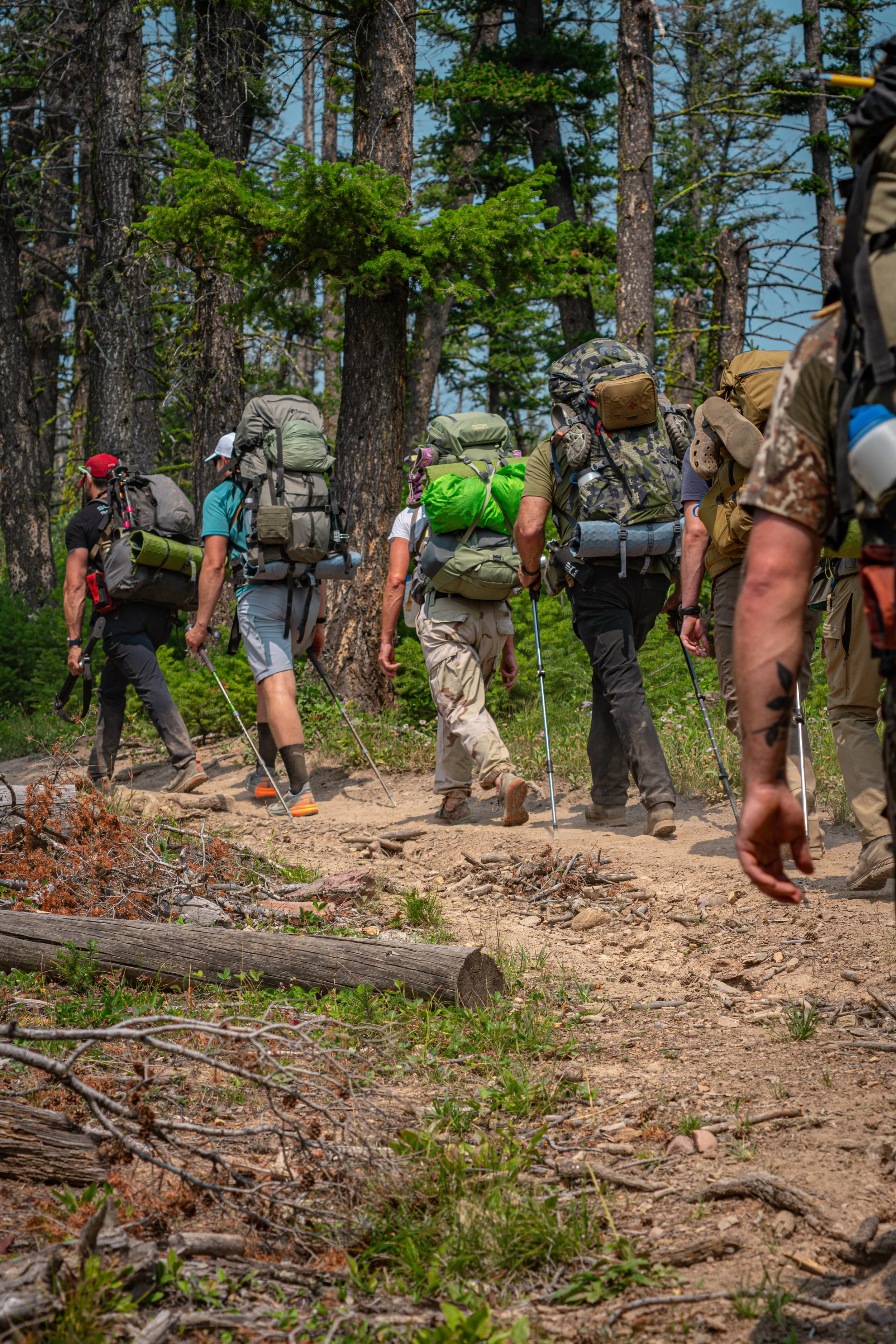
hiking in
The hike looks similar in structure. No hard wake up time, but there's coffee and breakfast before the morning routine. If you're up early enough, there's time to fish, same as on the float. Then you break camp and start moving.
Pace runs roughly twenty five minutes of hiking to a five minute break, adjusted as needed. You carry a snack bag that has to last all four days, same as the float. Stops happen for pictures, for filtering water, for longer lunch breaks, and at every stop there's a medic ready to handle hot spots before they become real problems, and a team leader ready to help adjust your pack if something's not sitting right. When you reach camp, you set up tents, refill water filters, break out team gear, and there's usually time built in for fishing or a nap before the day's classes, two to three of them, worked in along the way.
Here's where the hike is genuinely different, and we're not going to soften it. Daily mileage runs two to eight miles, and you're carrying at least forty pounds. Every hiking team also carries a section of the Pig Egg, which adds another seven to nine pounds to your finished pack weight no matter what. That's real weight, on real terrain, every day.
Because of that, this isn't a trip you sign up for and just show up to. You'll talk with our wellness coordinator before you're assigned to a hike, and there's a real chance he'll have you do a walk with weight first, before you're cleared. That's not gatekeeping. That's making sure the challenge you're stepping into is one you're actually ready for.
If what's pulling you toward this program is a physical challenge, not just a mental one, the hike is where you'll find it.
How to Actually Choose
Both trips will test you, just not the same way. The float tests your patience with weather you can't control and your willingness to work a shoreline when the current isn't doing it for you. The hike tests your body directly, mile after mile, with real weight on your back and a piece of the Pig Egg added to it. Neither one is the easy option. They're just different kinds of hard.
Suffering shows up in life whether you go looking for it or not. What decides whether that suffering does something for you is how you choose to go through it. If you want to see a stretch of Montana most people never will, put in real conservation work, and maybe catch a fish while you're at it, take the float. If you want to find out what you're made of with forty pounds on your back and miles still ahead of you, take the hike.
Bottom Line
Both trips are VLTATs. Both are gear supported, Both run four days, three nights, with fifteen veterans, a two to one leader ratio, and two to three classes worked into every day. The float puts you on the Smith River, working conservation labor and rowing when you want to, built to include veterans who need it more accessible. The hike puts real weight on your back over two to eight miles a day, with a section of the Pig Egg riding along. Pick the one that pulls at you harder, talk to your team leader if you're still not sure, and apply. Either way, you're getting the real thing.
